

Topic: “Regional Colonies”


When I saw this game at a local, family-owned game shop last year: I started to drool a little. I was SO strong though — despite every primal urge, I did *NOT* buy it. Until a week later. After researching it’s merits, I drove back to the little shop to give this game a good, loving home …tucking it away in my secret game-surprise-stash.
{Apparently I am part-squirrel because this stash is cached in random hiding spots throughout the house. And I know exactly where each one is. I’m always on the lookout for games that will coordinate with upcoming units b/c I’ve noticed my children become more vested into topics that involve interactive fun. I will explain further below!}
NEW BEDFORD: A GAME OF HISTORIC WHALING & TOWN BUILDING
In addition to sprouting strategy, this game teaches interesting historical details. For example, the longer you are playing (‘whaling’) the less whales there are in the ocean. Toward the end of the game the whale population dramatically declines. Here are a few other things students can learn during play:
- In order to score points, players need to pay the “lay” of their ship — a whaling term.
- The town of New Bedford starts small, and as players find success they invest in new buildings, making the city grow ever wider and more prosperous.
- As players choose what to build, they encounter terms such as ‘wharf’ and ‘cooperage.’
- Of course it also involves simple math–trading supplies, multiplying $4/whale x 3, etc. The math component of this game plays a key role in its strategy.
- It will surely cement “New Bedford” into the minds of my children as a New England town that got its start thanks to the sea.
Tucked within the game’s direction pamphlet are historical notes that tie to different aspects of the game. One example: “Historical Note: One of the most famous American whaling ships, the Essex, set sail from Nantucket, Massachusetts. In 1820 the ship was attacked by a sperm whale and sank. The novel Moby Dick was inspired by the accounts of 2 of the 8 survivors.”
So this game has oodles of potential for rabbit trails. For example, I have a teen, and I’m pretty sure he’s never contemplated reading Moby Dick in his free-time. But this game, and the study of whaling, makes the world of Moby Dick more enticing — and I plan to strew a copy in our library basket. (wink, wink!) My 8 year old was interested in the different types of whales within the game, and we happen to have a whale poster (thank you Uncle Ryan!) that I am going to finally hang up. I will be strewing whale books around here as well. Perhaps we’ll catch a documentary? We’ll see where interest takes us. I try not to plan our rabbit trails too far ahead, because inspiration is a fickle muse and when she flies we chase her to the next trail.
PS: If you want to know how to play New Bedford, I am not your girl. I’ll leave that task to google and all the brilliant videos and blogs out there that will show you better than I. Let me stop here to be REAL with you–I almost lost my mind trying to understand the directions my first time through. I mean, I was ready to pack the game away for a day of higher caffeination mixed with divine revelation — clearly lacking both at the time. I highly recommend reading the directions to yourself, ALONE, the first time…not with three pairs of eyes staring down you and your empty coffee cup, telling you they’re bored and hungry and then DING DONG! grandma and grandpa arrive for a surprise visit. I’m serious, this is my story of trying to launch this game. After the grandparents left I read the directions alone, then watched a tutorial — and THEN we were off and running. SO. WORTH. IT. I’m sharing that to say: don’t give up if at first glance the directions seem complicated (they’re really not) and goodness pete don’t present the game with fanfare like I did only to make your kids sit there listening to you read the directions while your hair turns grey before their eyes. Let’s just say: if your family likes Settlers of Catan, you’ll LOVE New Bedford. They have a similar feel, in that they are both town-building strategy games. Though I actually like New Bedford best! The town you build during game play has meaning — each building enhancing player options and adding new dimensions to the experience. New Bedford is now one of my top favorite games of all time; we’ll be playing this one often! And, it has a one-player option which I’m excited to try someday while ignoring laundry.
Week 3 of AS1 also launches the optional “Build the American Story” resource. This resource was probably the biggest selling feature for me, and I’ve been patiently waiting to dig into it with my kids! (I mention an economical method of printing it in a previous post, you can find that HERE.) Our first task was to build the port for the town of New Bedford. It comes with a long pier, a fisherman, a whaler, two small boats, a whaling ship, and ocean/shoreline background sheets showing a whale. This week we also built the New York Shipbuilder’s Shop, which is equally stunning — but was a bit of a learning curve!! I have a background in model building and am a whiz with an Xacto blade, but stumbled a bit through the wording of the WinterPromise directions. I plan to document our building process so that others who are interested in the “Build the American Story” resource can see what it’s like. As always–I’ll list the errors, tips, & tricks we come across at the end of each week’s post.

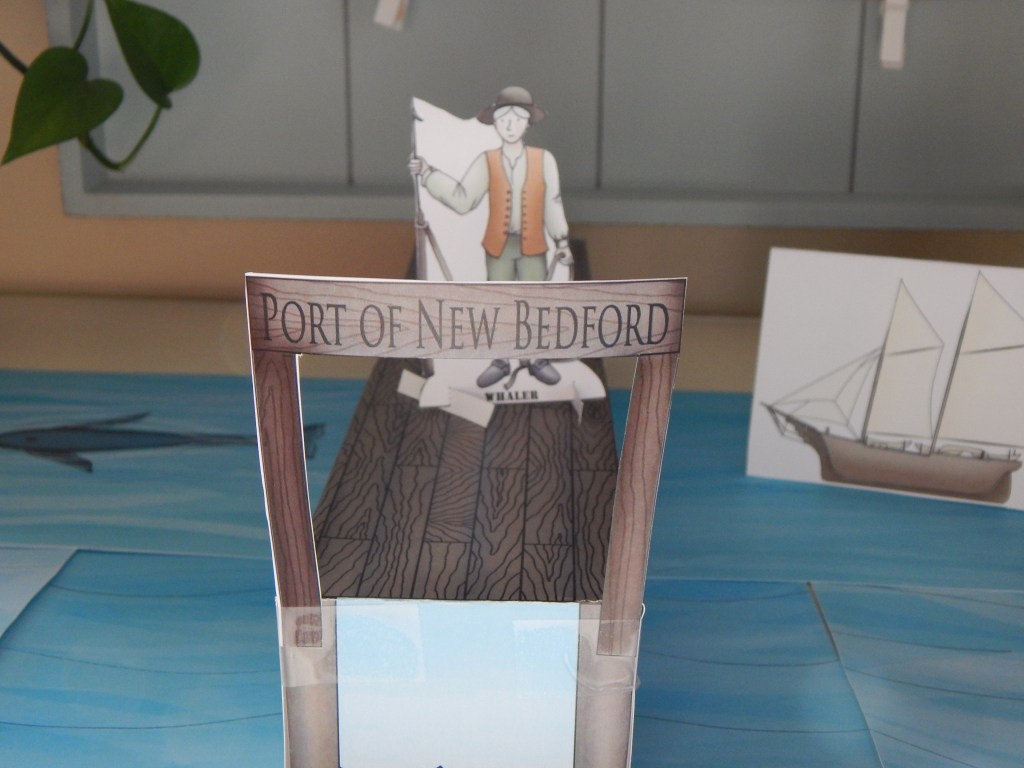
WEEK 3 ERRORS, TIPS, AND TRICKS:
ERRORS:
- In the Teacher’s Guide, two of this week’s optional Build It! projects aren’t listed. Under “Choose Among These Projects & Activities” add: “New York Shipbuilder” to Day 2, and “Plantation” to Day 3. (“New England Pier with Fishing Boats” is the only project listed in the TG this week, on Day 1, but all three projects coordinate with Week 3’s reading and are listed as Week 3 projects in the Build the American Story table of contents.)
TIPS & TRICKS:
- We chose to print only one copy of Build the American Story, since we will not have space to display more than one colonial village. I’ve found it saves a lot of time to hand out a few sheets to each child to cut out while I read aloud to them from the coordinating My American Story text. We do detail cutting and assembly afterward.
- These tools are very helpful to have on hand for village building: Xacto knife (for detailed interior cuts), cutting mat, and scotch tape.

 Saltbox Colonial
LOL. My son played a colonial colony recreation game called Made for Trade when he was using American Story. Who says learning can only happen in books?
LikeLike
Love it! I will have to look for that game, sounds very interesting. We love using games here ~ it’s such a nice change of pace. Thank you for chiming in. I love hearing about the games other people are playing!!
LikeLike